
March 2002, Issue No. 191
March 2002, Issue No. 191
A monthly report on environmental
and pesticide related issues
In This Issue

Pesticide
Applicator Training
Pesticide
Notification Network Update
Upcoming
Conferences/Announcements
2002
Drift Conference a Breath of Fresh Air
NOTE
ABOUT PRINTING A HARD COPY
Some AENews feature articles are available
in Portable Document Format (PDF) version, which is recommended for
printing. If you do not have Adobe
Acrobat Reader (required to read PDF files), this free program is
available for download at http://www.adobe.com/prodindex/acrobat/readstep.html
If you choose to print from the HTML version you currently see on
your screen, you may need to set your browser's printing preferences
so that no margins are cropped.
|
||
|
|
Pesticide Applicator Training | |
|
|
Pesticide Notification Network Update | |
|
|
Upcoming Conferences/Announcements | |
|
|
2002 Drift Conference a Breath of Fresh Air | |
NOTE
ABOUT PRINTING A HARD COPY
Some AENews feature articles are available
in Portable Document Format (PDF) version, which is recommended for
printing. If you do not have Adobe
Acrobat Reader (required to read PDF files), this free program is
available for download at http://www.adobe.com/prodindex/acrobat/readstep.html
If you choose to print from the HTML version you currently see on
your screen, you may need to set your browser's printing preferences
so that no margins are cropped.
Return to Agrichemical and Environmental News Index
Return to PICOL (Pesticide Information Center On-Line) Home Page
Clean Sweep 2001Dishing the Dirt on Nationwide Pesticide Disposal |
Click here for PDF version of this document (recommended for printing). Should you not have Adobe Acrobat Reader (required to read PDF files), this free program is available for download at http://www.adobe.com/prodindex/acrobat/readstep.html |
Nancy Fitz and Jude Andreasen, Office of Pesticide Programs, EPA
The U.S. Environmental Protection Agency (EPA) recently prepared a document entitled Clean Sweep Report 2001: State and Local Government Achievements in Disposal of Agricultural Waste Pesticides. The Clean Sweep Report is a summary of state and local government efforts to protect the environment by collecting and disposing of unwanted agricultural pesticides. It is currently being printed and should be available in paper and electronic form this month. (Watch EPA’s Web site, http://www.epa.gov/pesticides .)
Background
Over the past twenty years,
state and local governments have collected and safely disposed of more
than 24.6 million pounds of unwanted pesticides. These efforts, known
as “Clean Sweep programs,” focus on agricultural pesticides
but may also include other pesticides, such as those used by homeowners,
golf courses, or highway departments along their rights-of-way. There
is no federal mandate to conduct these collections.
Clean Sweeps are the results of state and local initiatives. The states
have adopted a variety of approaches to finance and implement their programs.
While some programs are conducted on the county level, the Clean Sweep
Report classifies the information by state. All of the programs have the
same goal: fostering environmental protection and pollution prevention
by removing these potentially hazardous materials from the environment.
Accomplishments
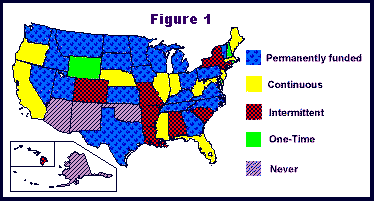 Forty-six
states have conducted at least one Clean Sweep program. As shown in Figure
1, the Clean Sweep Report divides states into five categories, which reflect
the frequency or permanency of the programs: permanently funded, continuous,
intermittent, one-time, and never. A permanently funded program is continuous
and has reliable, consistent funding in place year after year. Types of
permanent funding include state pesticide registration fees, other fee-based
funds that support clean up programs, and consistent state appropriations.
A continuous program is defined in this report as one that has been implemented
for at least three consecutive years, but without permanent funding. Although
continuous means “without interruption,” a program may still
be classified as permanently funded or continuous even if it occasionally
skips a year. An intermittent program is not continuous but has held more
than one collection event. A one-time program has held one collection
event. Four states have never had a collection.
Forty-six
states have conducted at least one Clean Sweep program. As shown in Figure
1, the Clean Sweep Report divides states into five categories, which reflect
the frequency or permanency of the programs: permanently funded, continuous,
intermittent, one-time, and never. A permanently funded program is continuous
and has reliable, consistent funding in place year after year. Types of
permanent funding include state pesticide registration fees, other fee-based
funds that support clean up programs, and consistent state appropriations.
A continuous program is defined in this report as one that has been implemented
for at least three consecutive years, but without permanent funding. Although
continuous means “without interruption,” a program may still
be classified as permanently funded or continuous even if it occasionally
skips a year. An intermittent program is not continuous but has held more
than one collection event. A one-time program has held one collection
event. Four states have never had a collection.
North Carolina held the first
Clean Sweep program in 1980. Maine and North Dakota followed with programs
in the early eighties. As other states initiated their own programs, the
number of states participating in Clean Sweep activities increased rapidly
from the late 1980s to the mid 1990s, as shown in Figure 2. Since 1995,
the number of states with programs has remained relatively constant, ranging
from thirty to thirty-four states. The number of states with permanently
funded programs has followed a similar pattern. There was a quick increase
in the first half of the 1990s with a steady but slower increase from
seventeen to twenty-one states since 1995.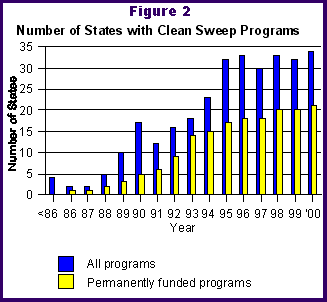
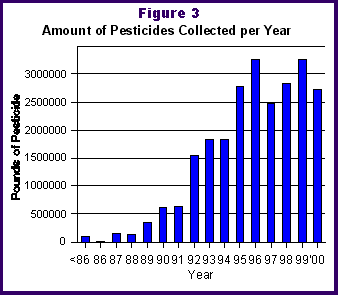
Based on data provided by the states, EPA estimates that Clean Sweep programs
nationwide collected over 24.6 million pounds of unwanted pesticides from
1980 through 2000. Figure 3 shows the amount of pesticide collected by
all programs per year. A relatively small amount of pesticide was collected
through 1991 – about 2.0 million pounds, or 8.1 percent of the total.
Since 1992, at least 1.5 million pounds of pesticides have been collected
each year and the annual total averaged almost 2.9 million pounds between
1995 and 2000.
Through December 2000, eleven states have collected over one million pounds of pesticides, including Texas with over three million pounds. Twenty-two states have conducted Clean Sweep programs for seven years or longer. In thirteen years of operation (through 2000), the program in Washington State collected almost 1.08 million pounds of pesticides. Run by the Washington State Department of Agriculture, this program is fully funded from the state Model Toxics Control Account. Participants do not have to pay for disposal. All state residents are eligible to participate, although home consumer pesticides are not accepted because most counties have household hazardous waste collection programs. (See schedule of this year's collection events in Washington toward the bottom of this month's newsletter.)
Program Operations
In nearly seventy-five percent of the states with Clean Sweep programs, the state’s Department of Agriculture or the pesticide regulatory agency has the lead for organizing and overseeing the program. Participation in Clean Sweep programs is sometimes limited to farmers and ranchers, although states are increasingly opening programs to include other participants, such as pest control businesses, dealers, golf courses, and homeowners.
Many programs are paid for using state general funds and/or state pesticide registration fees, but additional financial support is often obtained through participant fees, county funds, in-kind services, and, less frequently, EPA grants. Most Clean Sweep programs collect only pesticides, but some states have found that collecting several waste streams is more cost effective.
Twenty-five states use single-day events as their only collection method, but other states use combinations of single-day events, permanent sites, and on-site pick up. Generally, a hazardous waste contractor provides all materials and services for collection, including manifesting, packaging, transport, and disposal. Most collected material is incinerated as hazardous waste.
Observations
The twenty-one states with permanent funding have collected over 70 percent of all the waste pesticides collected nationwide. The principal advantage of permanent funding is that program managers with a predictable source of funds can devote their energy to program implementation.
Based on data from fifteen states, the cost per pound to dispose of unwanted pesticides has decreased significantly over the past decade. However, the cost of Clean Sweep programs is minor compared to the cost of cleaning up the pollution that can result from improper disposal of unwanted pesticides.
Looking Ahead
No one knows how many pounds of unwanted pesticides have yet to be collected in the United States. Estimating the total amount is difficult due to several factors:
- many farmers are reluctant to fill out government surveys;
- some stocks lie forgotten in barns until the owner dies; and
- unwanted pesticides still accumulate, due to overestimates of pest populations, changing crop patterns, new products, and cancellation of some uses of older products based on new risk assessments conducted under the Food Quality Protection Act.
Assuming pesticide management practices are consistent across the country, it is reasonable to expect that the higher a state’s pesticide usage, the higher its quantity of unwanted stocks. States that use the most pesticides have permanently funded or continuous Clean Sweep programs. States with longer-running programs generally have collected higher quantities of pesticides and a larger proportion of the amount of pesticides used since 1960. The quantity of unwanted pesticides collected and disposed by Clean Sweep programs is only a tiny fraction of the pesticides used in the United States.
Since even states with long-term, comprehensive Clean Sweep programs are still collecting pesticides, EPA believes that Clean Sweep programs will continue to be needed for the foreseeable future.
For More Information
The Clean Sweep Report will be posted on EPA’s Web site at http://www.epa.gov/pesticides . The on-line report will have links to each state’s program summary; the summaries will be updated periodically. If you have updates or corrections to the report or if you would like additional information about Clean Sweep programs, please contact us directly.
Nancy Fitz and Jude Andreasen are with the Environmental Protection Agency’s Office of Pesticide Programs. They can be reached at fitz.nancy@epa.gov , (703) 305-7385 or andreasen.jude@epa.gov , (703) 308-9342, respectively.
Waste Pesticide Disposal in WashingtonFor a schedule of Clean Sweep (pesticide disposal) events this year in Washington State, click here. |
Return to Table of Contents for the March, 2002 issue
Return to Agrichemical and Environmental News Index
Return to PICOL (Pesticide Information Center On-Line) Home Page
Adios Azinphos-Methyl, Farewell Phosmet |
Click here for PDF version of this document (recommended for printing). Should you not have Adobe Acrobat Reader (required to read PDF files), this free program is available for download at http://www.adobe.com/prodindex/acrobat/readstep.html |
Dr. Allan S. Felsot, Environmental Toxicologist, WSU
Within a year after the August 1996 passage of the Food Quality Protection Act (FQPA), the backslapping giddiness accompanying this legislative compromise between agricultural interests and environmental advocacy groups dissipated to consternation that perhaps all was not as it seemed. Agricultural groups pointedly accused the EPA of dismissing “sound science.” They believed EPA was showing an increasing propensity to curtail uses of OPs. Meanwhile, environmental advocates accused the EPA of lacking sufficient science about OPs. They suspected the agency was not faithfully and fully implementing the provisions of the FQPA.
Five years after the FQPA’s coming-out party, the scorecard reveals that OP insecticides increasingly are becoming relics of the past. But ironically, the specific mandates of the FQPA to protect consumers, especially infants and children, may turn out to be the least of the reasons for the flight of the OPs. While the illusion of excessive dietary exposure whipped up astonishing antagonism, the issues that may prevent practical use of OPs are turning out to be worker exposure and ecological concerns. The latest casualties illustrating this point are the orchard favorites azinphos-methyl (formulated as Guthion) and its cousin phosmet (formulated as Imidan).
How We Got From There to Here
Before considering the gory details of the attack on Guthion use in orchards, a bit of history is in order. The present state of affairs represents a convergence of a recently settled lawsuit against the EPA and the application of older amendments to the Federal Insecticide, Fungicide and Rodenticide Act (FIFRA), the overarching statutory authority for pesticide regulation.
Before the FQPA required EPA to reassess all pesticide tolerances by the year 2006, the agency was already engaged, albeit very slowly, in re-registration of products registered before 1984 as required by FIFRA and its periodic amendments. But re-registration encompassed more than just estimating dietary exposure and approving tolerances. Chief among the additional considerations during re-registration were the provisions of a 1972 mandate titled FEPCA (the Federal Environmental Pesticide Control Act). FEPCA broadened FIFRA’s myopic attention on human health and food residues to include worker exposure and ecological effects. FEPCA also gave rise to the classification of pesticides as either “general” or “restricted-use” products and brought about requirements for continual pesticide applicator training and licensing for application of restricted-use products. Concern for worker health was re-emphasized with implementation of the Worker Protection Standard (WPS) in 1994. Today, when EPA releases a RED (Registration Eligibility Decision Document), risks to workers and the environment are duly characterized (1).
During 1999, the advocacy group known as the NRDC (National Resources Defense Council) sued EPA over its failure to quickly implement all of the provisions of the FQPA. Specifically, NRDC based its case on EPA’s reluctance to conduct cumulative risk assessments (CRAs) of OP insecticides (2). In March 2001 the Federal court hammered out a consent decree between EPA and the NRDC in which EPA was mandated to faithfully carry out the provisions of the FQPA by pushing forward a CRA of OP insecticides. EPA finally released a very comprehensive draft CRA in December 2001 (3). What may have escaped the casual observer’s notice is that two little lines of this multi-page decree have enormous impact. They essentially broaden the scope of FQPA from consumer safety to worker and ecological protection. The consent decree of March 2001 commits EPA to conduct worker and ecological risk assessments.
Guthion in the Diet
The FQPA mandated that EPA re-evaluate all food residue tolerances for all pesticide products with special attention to five principle considerations: potential sensitivity of infants and children, potential to cause cancer, potential to affect the endocrine system adversely, aggregate exposure, and cumulative exposure. Despite being considered a very hazardous OP (Table 1), azinphos-methyl (AZM) did not trigger any concerns with regard to any of the principal considerations of the FQPA. Nevertheless, early assessments of dietary exposure to AZM residues led EPA to conclude that consumer exposure was excessive.
|
TABLE
1
|
||
|
Dose-response
parameters for AZM and phosmet insecticides (mg/kg/day unless otherwise
stated).
|
||
|
Azinphos-Methyl
|
Phosmet
|
|
|
Acute
Toxicity Parameters
|
||
|
Acute
Oral LD50 (rat) |
4.5 |
113 |
|
Acute
Dermal LD50 (rabbit) |
>2000 |
>5000 |
|
Acute
Inhalational LC50 |
>0.21
mg/L |
>0.152
mg/L |
|
RfD
for Consumer Risk Characterization
|
||
|
Acute
RfD |
0.0033 |
0.045 |
|
Chronic
RfD |
0.0015 |
0.011 |
|
Toxicity
Parameters for Workers' Short-Term Exposure
|
||
|
NOAEL
for Dermal Toxicity |
0.56 |
15.5 |
|
NOAEL
for Inhalational Toxicity |
0.32 |
4.5 |
|
Toxicity
Parameters for Workers' Intermediate-Term Exposure
|
||
|
NOAEL
for Dermal Toxicity |
0.36 |
1.1 |
|
NOAEL
for Inhalational Toxicity |
0.32 |
1.5 |
| 1/
RfD = Reference Dose 2/ NOAEL = No Observable Adverse Effects Level |
||
Refined assessments of exposure
based on actual field residues and monitoring results from the USDA Pesticide
Data Program (PDP) eventually muted concerns over chronic (daily lifetime)
exposure, but acute exposure to infants and children was still deemed
excessive (Table 2, composite apple residues). Bear in mind that acute
dietary risk characterization is very conservative because probability
modeling is used to estimate the 99.9th percentile of exposure for different
population subgroups (e.g., infants, 1-6 year olds, teenagers, etc.).
|
TABLE
2
|
||||
|
Risk
characterization for dietary exposure to azinphos-methyl with apple
composite residues and single serving residues 1/
|
||||
|
Apple
Composite Residues
|
Single-Serving
Apple Residues
|
|||
|
Population
Group
|
Residues
|
%
RfD
|
Residues
|
%
RfD
|
|
U.S.
Population |
0.001781 |
59 |
0.001285 |
43 |
|
All
Infants < 1 yr |
0.003003 |
100 |
0.002504 |
83 |
|
Children
1-6 yrs |
0.003913 |
130 |
0.002403 |
80 |
|
Children
7-12 yrs |
0.002704 |
90 |
0.000329 |
53 |
| 1/ Exposure (mg/kg/day) is compared to the acute reference dose (RfD) of 0.0033 mg/kg/day and expressed as a percentage of the RfD. Percentages less than 100% are interpreted as a reasonable certainty of no harm. Data were based on the revised draft RED (1999) and interim RED (2001) for AZM; both can be downloaded from http://www.epa.gov/pesticides/reregistration/status.htm | ||||
In its revised draft RED issued in 1999, EPA agreed to re-register AZM, but the agency required some changes in use patterns and a lowering of tolerances from 2 parts per million (ppm) to 1.5 ppm. Because residues hardly ever exceeded the tolerance, exposure was not really mitigated. However, the amount of permissible AZM use in one season was reduced. Finally, EPA said it would revisit registration of AZM within two years to determine whether exposure had been reduced.
Environmental advocates expressed concern that commodities eaten fresh like apples are consumed individually, while residues have traditionally been determined by blending together numerous apples to yield a composite average concentration. Owing to variations in spray coverage, the potential existed for individual apples to have residues far exceeding the composite average. As a result of this concern, EPA began demanding registrants to consider residues on individual pieces of fruit. The USDA-PDP started monitoring single servings of apples, pears, and raw potatoes (http://www.ams.usda.gov/science/pdp/index.htm).
EPA revisited dietary exposure to AZM by examining single-serving apples. Apples disproportionately influence the dietary exposure picture, as children consume a large amount relative to their body weight when compared to adults. Further, AZM is used on nearly 75% of U.S. apple acreage. If, as hypothesized, single-serving residues are extraordinarily high, then one would predict that acute dietary exposure would appear even more excessive. Ironically, EPA concluded in its most recent revision of the AZM RED, known as the interim or IRED (4), that dietary exposure based on single-serving analyses was even less than that estimated from composite residue data (Table 2, single-serving apple residues). Indeed, EPA claimed that dietary exposure to AZM was no longer a concern. (After that exercise, don’t be surprised if EPA no longer requires single-serving data for dietary exposure assessments!)
AZM’s Days Are Numbered
Despite relief from concerns about dietary exposure to infants and children, EPA placed AZM on the chopping block, essentially suspending the forty-three registered crop uses (4). For eight of the uses (apples and crabapples, pears, sweet cherries, blueberries, caneberries, Brussels sprouts, nursery stock, and southern pine seed orchards), EPA determined that benefits outweighed risks and decided to issue a time-limited registration of four years. In other words, the apple, sweet cherry, and pear growers have a four-year reprieve, but then the AZM tolerances will be revoked. EPA was able to take benefits into consideration because worker and ecological risks, not dietary risks, were the drivers behind EPA’s regulatory decision to not re-register AZM. The FQPA allows no considerations for benefits, but worker and ecological considerations are mandated by FEPCA and are therefore outside of the mandates of the FQPA.
Common sense alone dictates
that orchard workers will be exposed to AZM, but should workers be held
to the same margins of safety that we bestow on infants and children?
In other words, how much risk is a worker allowed to bear and is it unreasonable?
Worker Worries
The process of determining risks to workers is essentially the same as for consumers, but routes of exposure are different. For example, dietary and drinking water exposure are irrelevant. Workers are exposed during mixing, loading, and application of pesticides through either the skin (dermal) or through breathing (inhalational). Thus, EPA prefers to use the no observable adverse effect levels (NOAELs) from rodent dermal and inhalation short- and intermediate-term exposure studies as the hazard benchmark for assessing the degree of worker exposure (Table 1). For OP insecticides, the NOAEL has been almost exclusively based on the most sensitive effect: inhibition of the nerve-signal modulating enzyme acetylcholinesterase that is found in red blood cells as well as in nervous tissue.
For any cropping system, EPA examines exposure based on work activity, length of exposure, and use of various kinds of PPE (personal protection equipment) and engineering controls (closed mixing/loading systems and enclosed tractor cabs). Exposure information comes from a combination of field experiment data (if available) and a database called PHED (Pesticide Handler Exposure Database). PHED consists of worker exposure studies collected over many years from industry. The data include unit exposures for different types of worker activities. The specific chemical being assessed is less relevant than the application rate, acres treated, and length of time worked.
For post-application exposure, such as would occur for tree proppers, fruit thinners, and hand harvesters, the residues on leaves that are easily transferred to skin (called dislodgeable foliar residues, DFRs) are estimated by extracting leaves with water containing a surfactant. Although the major cropping systems are represented in the PHED, the effects of specific changes in application or harvesting practices on unit exposure parameters and/or DFRs must be estimated to reflect currently relevant or proposed practices.
The calculated exposures for the different worker scenarios are compared to the dermal and inhalational NOAEL for short-term (1-7 days) and intermediate term (one week to several months) exposure (Table 1). The ratio of the NOAEL to the exposure is called the margin of exposure (MOE). MOEs less than 100 require exposure reduction.
For each registered AZM use, EPA calculated that many worker activity scenarios had MOEs less than 100. For example, MOEs for mixing/loading and application of 1 lb AZM/acre in apples ranged from 22 to 64 (Figure 1). Pertinently, EPA concluded the risk could not be further mitigated because exposure scenarios already considered full PPE and maximum engineering controls.
|
FIGURE
1
|
|
Risk
characterization of worker exposure to azinphos-methyl during mixing,
loading, and application in apples.
|
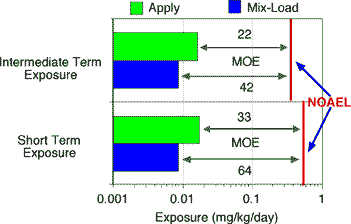 |
| Assumptions are 1.5 pounds of active ingredient per acre and maximum personal protection equipment and engineering controls (e.g., water soluble insecticide bags). The MOE is represented by the arrows between the NOAEL (heavy [red] vertical lines) and the magnitude of exposure (wide [green and blue] bars). |
EPA was especially concerned about post-application practices because they yielded the lowest MOEs based on current restricted-entry intervals (REIs) (Table 3). REIs are the number of days after an application before a worker can enter the treated area. They are essentially exposure reduction standards and ideally should coincide with MOEs of 100 or greater. To achieve an MOE of 100 in apples, REIs for propping, scouting/irrigating, and thinning/hand harvesting would have to be set at 32, 79, and 102 days, respectively. Compared to the current REI of two days for propping, scouting, and irrigating, and fourteen days for thinning and harvesting, the acceptable risk REIs obviously would be impractical.
|
TABLE
3
|
|||||
|
Risk
characterization for post-application exposure of workers to Guthion.
1/
|
|||||
|
DAT
|
Task
|
DFR
(µg/cm2)
|
Transfer
Factor (cm2/hr)
|
Exposure
(mg/kg/day)
|
Short-Term
MOE
|
|
2 |
Propper |
1.56 |
100 |
0.0178 |
31 |
|
2 |
Irrigation, Scouting, Weeding |
1.56 |
1000 |
0.1783 |
3 |
|
2 |
Thinner |
1.56 |
3000 |
0.5349 |
1 |
|
7 |
Harvester |
1.26 |
3000 |
0.4320 |
1 |
|
14 |
Harvester |
0.93 |
3000 |
0.3189 |
2 |
|
21 |
Harvester |
0.7 |
3000 |
0.2400 |
2 |
| 1/ DAT = days after treatment; DFR = dislodgeable foliar residues; Transfer Factor = surface area of skin exposed during one hour of activity; Exposure = (DFR x Transfer Factor x hours worked [8]) / body weight [70kg]; MOE = margin of exposure calculated as the ratio of the NOAEL (0.56 mg/kg/day for AZM) relative to the exposure. | |||||
AZM Does the Regulatory Limbo
Eight crop uses received time-limited registrations because the benefits of AZM were determined to exceed the risks of adverse effects on workers even though MOEs were substantially less than 100 (4). In four years, the registrant, Bayer Corporation, will have to request an extension of the registration. Additionally, the time-limited registration required changes in the product label and submission of new data, such as the following (for use in apples):
- Limit maximum yearly use
to 3.5 lbs per acre east of the Mississippi River and 4.0 lbs per acre
west of the Mississippi;
- Increase REI to 14 days
for all worker activities;
- Require closed mixing systems
or water soluble bags and closed transfer systems for mixing/loading;
- Require enclosed cabs or
maximum PPE for applicators;
- Prohibit aerial application;
- Add spray drift language;
- Orient nozzles on airblast
sprayers inward;
- Add 25-foot no-spray buffer
zones around permanent surface water;
- Add bee warning statement;
- Encourage development of
Pest Management Strategic Plans (see Et Tu, Phosmet? below).
In addition to required label
changes, Bayer will have to submit new study data, including:
- Biomonitoring study of worker
harvesting and thinning activities that would measure both cholinesterase
and AZM biomarker levels (studies must be conducted in the Pacific Northwest,
the Northeast, and California);
- Full fish life-cycle toxicity
study;
- Ground water monitoring;
- AZM usage information during
the next three growing seasons;
- Information about alternative
insecticides under development or commercialized;
- Exposure-reduction feasibility study of post-application use of protective gloves.
Reality Checks
The selection of an MOE of 100 for protection of workers is strictly a risk management decision. Risk management decisions are social, not scientific. An MOE of 100 is the same safety factor represented in the RfD that is applied to dietary risk characterization. While toxicology cannot dictate what a sound MOE should be for worker risk characterization, epidemiology can show the propensity for worker health effects to be associated with pesticide use. Worker activities associated with MOEs less than 100 should have a greater probability of resulting in worker health effects than activities with MOEs greater than 100. One way to determine whether this hypothesis is valid is to examine the incidence of worker poisonings and place them into perspective with the number of applications.
Worker exposure and health effects incidents are tracked by state poison control centers, state health agencies, and the EPA. The resulting databases can be used to examine frequency of complaints about AZM. For example, in a 1985 cholinesterase surveillance study of over 500 workers in California (cited in Reference 4), 94 workers had marked cholinesterase inhibition (i.e., >20% inhibition compared to an individual’s own baseline enzyme activity). Of these, 11% or 10 workers were definitively exposed to AZM. To calculate the incidence of worker exposure per application, consider that California grows nearly all of the United States’ almonds, walnuts, and pistachios, which are heavily reliant on use of AZM. EPA had estimated that 289,000 pounds of AZM were used yearly on these crops. At the recommended rate of application, a total of almost 130,000 acres would have been treated. If we assume conservatively that a worker could treat five acres with one tank full of AZM mixture, then 25,980 tanks of AZM would have been mixed just to treat these tree nuts. Because each tank load has to be prepared anew, the incidence rate of workers with excessive cholinesterase inhibition per tank load would be 10 divided by 25,980 or 0.000398. So in 1985, approximately one worker was overexposed for every 2500 tank mixes (or individual applications) of AZM. Is that an excessive risk, as EPA’s calculations of MOE suggest? To reiterate, such a judgment is purely a social decision, not a scientific one.
Similar estimates of worker health effects incidence rates can be calculated for other crops on which AZM is used, such as apples. EPA stated in the AZM IRED that about sixteen cases of AZM poisonings are reported each year. As a worse case, we will assume that all of these poisonings were related to apple production. EPA’s estimates for AZM use are 890,000 pounds; at an application rate of 1.5 lbs/acre, the equivalent of 593,000 acres of apples would be treated. If five acres can be treated with each tank full of spray mixture, then 118,667 applications (i.e., refilled spray tanks) are made during a growing season. Thus, one worker reports AZM symptoms for every 7,690 applications.
Because post-application workers were determined to have the greatest risk by virtue of their estimated exposure being very close to the NOAEL, it is instructive to estimate the incidence of poisonings relative to the number of workers engaged in harvesting. EPA estimated that 45,000 workers are engaged in picking apples nationwide. If all sixteen poisoning incidents reportedly due to AZM each year occurred with apple harvesters (an extremely conservative proposition, as apples account for only 40% of AZM use), then the incidence rate is 0.04%. In other words, one out of about 2500 apple pickers could be reporting symptoms from AZM exposure each year. While excessive exposure to any pesticide is always unacceptable, reality dictates that farming is like any other business. So, a pertinent question is to ask how the estimated injury incidence rates compare to other industries.
The Bureau of Labor Statistics (BLS) of the U.S. Department of Labor compiles a database of injury and illness incidence rates for all major industries in the United States. (Their Internet URL is http://stats.bls.gov/iif/oshsum.htm.) The illness incidences are broken down by causes, including the separate categories of “poisoning” and “respiratory conditions due to toxic agents.” The BLS estimated that 169,400 workers were employed for all of the fruit and tree nut industries during 2000, and further estimated a poisoning incidence rate of less than 0.05 per 10,000 workers. Because labor departments are not as efficient at collecting on-farm pesticide incidents data as agencies that specialize in collecting that data, the average sixteen poisoning incidents from AZM can be prorated to all fruit and nut tree employees, thereby yielding the much higher incidence rate of 0.94 (or about one person reporting poisoning out of 10,000 workers). For a comparison to other industries, let’s choose the chemicals and allied products manufacturers because those workers also handle hazardous chemicals and are thus likely to have higher than average exposures. For all types of chemical manufacturing, the poisoning incidence rate was 0.3 per 10,000 workers, but it varied by specific industry. For example, workers in the agricultural manufacturing industry (51,000 workers) had an incidence rate of 1.3. Surprisingly, workers in the innocuous-sounding medicinals and botanicals manufacturing industry (28,200 employees) had an incidence rate of 3.4. So, in comparison to other workers that have definitive chemical exposures, fruit and tree nut workers do not appear to be experiencing an unusual incidence of poisonings owing to AZM use. To reiterate an earlier point, everyone wants to avoid worker illnesses, but farm workers do not seem to be getting sick at extraordinary rates in comparison to other workers who handle chemicals.
Et Tu, Phosmet?
Phosmet is another OP insecticide that is currently crucial to the orchard industry. Like AZM, its benefits exceed its risks. By both oral and dermal exposure, phosmet is significantly less acutely toxic than AZM and the selected RfDs were nearly tenfold greater (Table 1). Consequently, the revised draft dietary risk assessment dispelled any concerns about excessive acute and chronic exposure (5). Unlike AZM, however, phosmet does have residential uses, including pets, household ornamentals, and residential fruit trees. But according to its IRED, aggregate exposure assessment still raised few concerns about excessive consumer exposure. The only problem areas involved toddlers touching treated dogs and homeowners treating backyard fruit trees with a hand wand sprayer. Phosmet’s registrant, the Gowan Company, has requested voluntary cancellation of all residential uses, thus making moot any concerns over aggregate risk.
For thirty-three registered crop uses, worker exposure did not exceed EPA’s levels of concern if appropriate PPE was used. However, nine of the registered uses posed post-application worker exposures unacceptable to EPA. The crops included apples, crabapples, apricots, high-bush blueberries, peaches, pears, plums/prunes, nectarines, and grapes. Specifically, EPA determined that the MOEs for post-application exposure were close to 10 at the current REI of twenty-four hours. Not until thirty-four days after application did MOEs rise to 100.
Because phosmet, like AZM, had extraordinarily high benefits for use on fruit trees, EPA decided to issue a time-limited re-registration for the nine uses presenting excessive post-application worker exposure. EPA forged an agreement with Gowan Company to consider re-registration after five years, but the REIs would be extended from the interim three days to 13-29 days. For example, in 2006, phosmet could only be used if the REI for apples was extended to 13 days for a 1.5 pound per acre application (lbs/A) or 28 days for the 4 lbs/A rate. In addition, Gowan agreed to conduct a cholinesterase monitoring study with post-application workers, as well as to continue providing EPA with information about phosmet usage and benefits.
Finally, during the time-limited registration, EPA encouraged growers and commodity organizations to develop or expand Pest Management Strategic Plans (PMSPs). PMSPs are stakeholder-driven, commodity-specific plans that identify current and emerging pest management practices. PMSPs also state a commodity's priorities for research, regulatory activities, and education/training programs to support transition to alternative pest management practices. (See http://www.pmcenters.org for more information and see related article in this issue regarding an upcoming opportunity to learn about PMSPs in Spokane, Washington, April 9, 2002.)
It Ain’t Over Until the CRA Sings
Concerns over excessive worker exposure to OPs, especially to fruit thinners and harvesters, seems to have supplanted concerns about consumer risk now that methyl parathion, chlorpyrifos, and diazinon uses have been significantly curtailed. The time-limited registrations of AZM and phosmet are prime examples of OP uses that will be nixed unless the registrants generate new information and follow all agreements about REIs and other risk mitigation procedures.
It is important to remember a critical difference between consumer risk and worker exposure: when assessing the latter, EPA can weight benefits against risk. AZM and phosmet are the only effective codling moth control products on the market. Even growers who are using the biologically friendly, pheromone-based mating confusion systems require at least one insecticidal cover spray to knock down moth populations for optimal control. AZM is currently a critical pesticide for control of cherry fruit fly because phosmet poses a risk of phytotoxicity to sweet cherries (5). The benefits of AZM and phosmet are clear, and will lessen only as newer, reduced-risk pesticides with activity against codling moth and cherry fruit fly join the marketplace.
But before reconsidering benefits, EPA will revisit consumer risk. In the preliminary CRA for OPs, EPA declined to state specifically what the results meant for the future of the OPs (2). EPA could conceivably make the decision to further restrict those OPs that are driving the comparatively higher dietary exposures of children. As the favorite insecticide for children’s favorite fresh fruit, AZM could be vulnerable to further restrictions even if worker exposure concerns are eventually resolved.
Dr. Allan S. Felsot is an
Environmental Toxicologist with WSU’s Food and Environmental Quality
Lab on the Tri-Cities campus. He can be reached at (509) 372-7365 or afelsot@tricity.wsu.edu.
REFERENCES
1. Felsot, A. S. 1999. Worker exposure and the FQPA: It’s in the RED! Agrichemical and Environmental News (March) 155. http://aenews.wsu.edu/Mar99AENews/Mar99AENews.htm
2. Felsot, A. S. 2002. Necessity is the mother of invention: EPA unveils preliminary CRA on OPs. Agrichemical and Environmental News (January) 189. http://aenews.wsu.edu/Jan02AENews/Jan02AENews.htm
3. U.S. Environmental Protection Agency. 2001a. Preliminary Cumulative Risk Assessment of the Organophosphorus Pesticides. Released December 3, 2001. Office of Pesticide Programs, U.S. EPA. Washington, D.C. (Downloaded report and appendices December 5, 2001 via http://www.epa.gov/pesticides)
4. U.S. Environmental Protection Agency. 2001b. Interim Reregistration Eligibility Decision for Azinphos-Methyl, Case No. 0235. Released October 31, 2001. (PDF file downloaded from http://www.epa.gov/pesticides/reregistration/status.htm)
5. U.S. Environmental Protection Agency. 2001c. Interim Reregistration Eligibility Decision for Phosmet, Case No. 0242 (PDF file downloaded from http://www.epa.gov/pesticides/reregistration/status.htm)
Return to Table of Contents for the March, 2002 issue
Return to Agrichemical and Environmental News Index
Return to PICOL (Pesticide Information Center On-Line) Home Page
The Value of PMSPsFree Workshop Offered April 9 |
Click here for PDF version of this document (recommended for printing). Should you not have Adobe Acrobat Reader (required to read PDF files), this free program is available for download at http://www.adobe.com/prodindex/acrobat/readstep.html |
Dr. Catherine H. Daniels, Pesticide Coordinator, WSU
In the March
2000 issue of Agrichemical and Environmental News (Issue No. 167),
I introduced readers to the concept of Pest Management Strategic Plans
(PMSPs). These plans were, at that time, a relatively new tool developed
by the U.S. Department of Agriculture’s Office of Pest Management
Policy (USDA OPMP). In that article (“Pest
Management Strategic Plans: Transitioning from Transition Strategies”),
I explained that PMSPs were a way for stakeholders representing a given
agricultural commodity to position themselves to negotiate with the U.S.
Environmental Protection Agency (EPA) in the event of the cancellation
of a chemical control important to their industry. By proactively gathering
data about key pests, possible alternatives to current uses, and the influences
of various alternatives on existing IPM programs, and by estimating the
time necessary to effect a transition (should one be necessary), industry
can be prepared to conduct a productive dialogue with EPA. The alternative
could be a loss of effective tools, or even a loss of some minor crops.

PMSPs are voluntary documents initiated by stakeholders: growers, processors, researchers, and other industry leaders. The experience of the last two years has shown that the ideal mechanism for launching and hammering out the details of a PMSP is in a facilitated, face-to-face meeting. In order to cover all the bases, such a meeting can take a full day or two. Why such a formal process, and why face-to-face? Because it works. The issues that arise in the course of these discussions are numerous and complex, and they require open, yet structured, discussion.
No one should be in business without a plan. Most of us know from experience that formally prioritizing our needs is a critical first step toward focusing our efforts and our resources. A PMSP can be one part of the larger, overall business plan routinely developed by any industry. The more complete your business plan, the better your industry is able to withstand a changing marketplace, which includes current and forecasted changes in the regulatory arena.
Besides serving as blueprints for the industry they represent, PMSPs are used by EPA in their review of pesticides as mandated by the Food Quality Protection Act of 1996. Industries that have produced a PMSP find that they have a myriad of other practical uses as well. Karen Ross, President of the California Wine Grape Growers Association, feels that their PMSP was an excellent use of time and resources that has returned many dividends to their industry.
 Are
you interested in learning more about these plans? Washington State University,
along with USDA and the Washington State Department of Ecology (WDOE),
are sponsoring a workshop to explain PMSPs in detail. This three-hour
workshop will feature speakers from USDA’s Western Region Pest Management
Center and from EPA's Biological and Economic Effects Division, who will
discuss what PMSPs are and explain how they are used now by USDA and EPA
in the review of pesticides. WDOE’s speaker will discuss how PMSPs
will be used by their department. Karen Ross will explain in detail how
this document has helped the wine grape industry focus efforts and obtain
resources to address their pest management needs. My part of the program
will cover how you can initiate a PMSP and what resources are available
to assist that effort.
Are
you interested in learning more about these plans? Washington State University,
along with USDA and the Washington State Department of Ecology (WDOE),
are sponsoring a workshop to explain PMSPs in detail. This three-hour
workshop will feature speakers from USDA’s Western Region Pest Management
Center and from EPA's Biological and Economic Effects Division, who will
discuss what PMSPs are and explain how they are used now by USDA and EPA
in the review of pesticides. WDOE’s speaker will discuss how PMSPs
will be used by their department. Karen Ross will explain in detail how
this document has helped the wine grape industry focus efforts and obtain
resources to address their pest management needs. My part of the program
will cover how you can initiate a PMSP and what resources are available
to assist that effort.
There is no charge to attend the workshop, but it is important to register if you are interested in attending so that we don’t have to turn anyone away by renting a too-small room. Your attendance is not a commitment to participate in a PMSP; the purpose of this workshop is simply to discuss their value and explain how your industry might initiate one.
 In
order to share resources, this workshop is being held in Spokane April
9, 2002, in conjunction with the WDOE Fourth Annual Nonpoint Pollution
Conference. The shared registration form for the PMSP workshop and the
Nonpoint Pollution Conference can be found on the Internet at: http://www.ecy.wa.gov/programs/wq/nonpoint/conference/cleanerwater/index.html
. You need not attend any of the WDOE conference in order to attend the
free PMSP workshop (listed on the registration form as “Pesticide
Workshop”) on April 9.
In
order to share resources, this workshop is being held in Spokane April
9, 2002, in conjunction with the WDOE Fourth Annual Nonpoint Pollution
Conference. The shared registration form for the PMSP workshop and the
Nonpoint Pollution Conference can be found on the Internet at: http://www.ecy.wa.gov/programs/wq/nonpoint/conference/cleanerwater/index.html
. You need not attend any of the WDOE conference in order to attend the
free PMSP workshop (listed on the registration form as “Pesticide
Workshop”) on April 9.
Representatives from every Washington State agricultural industry should really consider attending this workshop to learn about a voluntary program that can assist your industry in prioritizing and focusing efforts and resources and to address your critical pest management needs. Please feel free to contact me at (509) 372-7495 or cdaniels@tricity.wsu.edu if you have any questions about PMSPs or the workshop.
Dr. Catherine Daniels is the Pesticide Coordinator for Washington State University. She manages the Pesticide Information Center (PIC), which is located on the Tri-Cities branch campus (http://picol.cahe.wsu.edu ), and is Managing Editor of AENews.
Return to Table of Contents for the March, 2002 issue
Return to Agrichemical and Environmental News Index
Return to PICOL (Pesticide Information Center On-Line) Home Page
2002 Drift Conference A Breath of Fresh Air |
Click here for PDF version of this document (recommended for printing). Should you not have Adobe Acrobat Reader (required to read PDF files), this free program is available for download at http://www.adobe.com/prodindex/acrobat/readstep.html |
Carol Ramsay, Pesticide Education Coordinator, WSU
Under the direction of Sherman Takatori, Idaho State Department of Agriculture (ISDA), the Pesticide Applicator’s Drift Conference was held February 5 and 6, 2002 in Coeur d’Alene, Idaho. Appreciation e-mails from attendees started arriving on February 7, attesting to the success of the conference, which attracted over 150 attendees.
Pat Takasugi, ISDA Director, opened the conference with his thoughts about American agriculture. He stated the need for increased respect and appreciation for American agriculture and challenged the American public and policy makers to recognize that American agriculture operates under the highest overall global production standards, responding to social, health, and environmental regulations imposed on both the state and federal levels. Key message: Buy American!
The legal implications of drift were discussed in detail. Dennis Gardisser, University of Arkansas, told the audience tales about being an expert witness in drift litigation. Stressing the importance of accurate and thorough documentation, his bottom-line message was “Keep it All!” Applicators must document their professionalism, keeping records even for those instances where the decision was made not to apply. Mary Feeny, Idaho Deputy Attorney General, presented the legal foundation for civil litigation including negligence, nuisance, strict liability, and trespass. She discussed the Idaho state codes to which Idaho applicators should refer. Her message was “DRIFT: Do Remember Investigate First Thing.” She advocates investigating the application site and neighboring properties for sensitivities prior to conducting the job.
One of the hottest topics of the conference was presented by Jay Ellenberger from the U.S. Environmental Protection Agency Office of Pesticide Programs (EPA OPP). Ellenberger presented EPA’s proposal for guidance drift label language. To a diverse audience, including specialists in turf and ornamentals, agriculture, forestry,and rights of way, he explained some of the background, terminology, and reasoning behind the proposed changes. Conference attendees had the opportunity to talk with Ellenberger in person in addition to attending his informative presentation. It is not every day that we have the key EPA representative from Washington, D.C. here in the Pacific Northwest. For those AENews readers who were unable to attend the conference and share their views with Ellenberger, the deadline for comments about the drift label language has been extended to March 31, 2002. Go to Internet URL http://www.epa.gov/opppmsd1/PR_Notices/prdraft-spraydrift801.htm .
Barbara Morrissey, Washington State Department of Health, presented information on alleged and confirmed pesticide incidents. She detailed drift-related cases and whether cases were related to agricultural or non-agricultural settings. Jim Baker, ISDA, discussed risk assessment. Both speakers provided evidence supporting the case for drift management.
The conference also included a number of technical presentations in which issues were discussed such as the new droplet spectrum classification system, application technology (different sprayers, new nozzles, spray adjuvants), establishment of “no spray zones” or buffer zones, and the use of integrated pest management.
Attendees from Idaho, Montana, Oregon, and Washington had the opportunity to meet for an hour with their states’ regulators and educators to discuss current state-specific issues on pesticide drift or application
A session on how the media report drift and other agricultural issues was quite popular. Three media representatives (two from print and one from radio) openly fielded audience questions about story decision-making, reporter interviews, headlines, media bias, and media accountability. The panel members all did a superb job of detailing their professional decisions and were applauded for their gumption and their willingness to give up their morning for the honor of being grilled.
Quality meetings such as this help pesticide applicators and regulators stay on top of their business and increase their professionalism. EPA Region X is acknowledged as the key contributor for the conference. I represented Washington State University and contributed by contacting preeminent speakers in the field of drift mitigation. The Idaho State Department of Agriculture’s conference staff is recognized for their efforts in coordinating a top-notch conference.
Carol Ramsay is the Pesticide Education Coordinator for Washington State University. She can be reached at (509) 335-9222 or ramsay@wsu.edu .
Return to Table of Contents for the March, 2002 issue
Return to Agrichemical and Environmental News Index
Return to PICOL (Pesticide Information Center On-Line) Home Page
Pesticide Applicator Training
Washington State University (WSU) provides pre-license and recertification training for pesticide applicators. Pre-license training provides information useful in taking the licensing exam. Recertification (continuing education) is one of two methods to maintain licensing. The other is retesting every five years.
Course registration including study materials is $35 per day if postmarked 14 days prior to the first day of the program you will be attending. Otherwise, registration is $50 per day. These fees do not include Washington State Department of Agriculture (WSDA) licence fees. For WSDA testing sites, schedule, or other testing information, call 1-877-301-4555.
For more detailed information about WSU's pesticide applicator training, call the Pesticide Education Program at (509) 335-2830 or visit the Web site at
http://pep.wsu.edu/education/educ.html
Return to Table of Contents for the March, 2002 issue
Return to Agrichemical and Environmental News Index
Return to PICOL (Pesticide Information Center On-Line) Home Page
PNN Update
The Pesticide Notification Network (PNN) is operated by WSU's Pesticide Information Center for the Washington State Commission on Pesticide Registration. The system is designed to distribute pesticide registration and label change information to groups representing Washington's pesticide users. PNN notifications are now available on th PNN Web page. To review those sent out two months prior to this issue's date, either access the PNN page via the Pesticide Information Center On-Line (PICOL) Main Page on URL http://picol.cahe.wsu.edu/ or directly via URL http://www.pnn.wsu.edu. If you have any comments about the PNN, contact coordinator Jane Thomas at jmthomas@tricity.wsu.edu.
Return to Table of Contents for the March, 2002 issue
Return to Agrichemical and Environmental News Index
Return to PICOL (Pesticide Information Center On-Line) Home Page
Announcements & Upcoming ConferencesPesticide Stewardship Conference Call for PapersThe Third Annual Conference on Pesticide Stewardship, to be held from August 25 to 28, 2002, offers an opportunity to participate in one of North America’s most dynamic forums on pesticide stewardship. Sponsored by the National Pesticide Stewardship Alliance (NPSA), this event brings together a diverse range of public and private sector organizations to discuss today’s most pressing stewardship topics. The conference is meant to inform, challenge, and resolve. Great emphasis is placed on interactive sessions where participants, both presenters and attendees, can sit down and talk through topics of common concern. Organizations with members attending NPSA conferences include Ag Container Recycling Council (ACRC), Environmental Protection Agency (EPA), CropLife America (formerly American Crop Protection Association), American Association of Pesticide Safety Educators (AAPSE), Ag Retailers Association (ARA), and National Pest Management Association (NPMA). In addition, state pesticide collection programs and their hazardous waste contractors along with state container recycling programs use NPSA as their principal networking and conference site. This year’s conference will be held, for the first time, in the Pacific Northwest. Conference headquarters will be the beautiful and convenient Renaissance Madison Hotel (part of the Marriott Hotel chain), located near the Seattle waterfront. Trolley and monorail systems are available nearby to take visitors to local attractions. The Seattle area in late summer is one of North America’s most ideal vacation destinations. Salmon are running, the skies are clear, temperatures are warm, and numerous attractions, (e.g., World’s Fair Space Needle, Museum of Flight, harbor tours, Pike Place Market, Pioneer Square) are immediately available. We urge anyone considering a wonderful vacation location to consider this opportunity. To see the many scenic, recreational, cultural, and historical opportunities in the Seattle area, visit these Web sites: http://www.tourism.wa.gov and http://www.seeseattle.org. The Call for PapersThose interested in presenting a technical paper or arranging for a technical session must submit a 100-word abstract before April 12, 2002. As a technical paper presenter, you will be eligible for a $100 reduction in registration fees. Technical presentations usually run about twenty minutes. A wide range of topics will be considered, everything from reports on new products (e.g., software, container recycling and drift control equipment) to case studies of state or local pesticide disposal programs to training methods or materials for end-users and dealers to policy perspectives on current trends or regulatory actions (e.g., Talent decision, Universal Waste Rule, closed-loop systems). For the Seattle conference, we are particularly interested in submissions in the following areas:
***To
submit an abstract, contact Virginia Prest at prestv@wsu.edu
or by fax at (509) 786-9370.*** Room ReservationsLate August is the PRIME TOURIST SEASON in Seattle; reserve early to assure conference lodging. NPSA has worked with the Renaissance Madison to hold a block of lower cost government and non-government rooms. To reserve your room, contact the Madison at 800-278-4159. Dollar-Saving OpportunitiesNPSA
is fully aware of the difficult economic times facing all organizations.
We want you to attend this special Seattle conference, so we have
prepared a special set of money-saving opportunities and reminders
for you to consider. Please check them out at http://www.npsalliance.org.
You will be surprised at how economical Seattle can be with the
right planning! Seattle Conference ExtrasAny conference needs some attractive features to add extra excitement and interest. Here is what is being planned for Seattle: a Grand Reception Puget Sound recreational cruise; a tour for spouses; a “Welcome Reception” with an information exchange; pre-conference, half-day training sessions; an “on-the-road” session featuring salmon migration and endangered species; and a professional tour of nearby agricultural facilities and crop lands.
Questions about the conference can be directed to Kathy Brooks
at 877-920-6772 or kbrooks@arrowchase.com The
3rd Annual Conference on Pesticide Stewardship
|
||||||||||||||||||||||||||||||||||||||||||||||||||||||||||||||||||||||||||||||||||||||||||
Spring 2002 (dates remaining) |
|||
| Collection Site (Nearest City) | Collection Date | Sign Up by | Inventory to WSDA by |
| Ellensburg | April 22 | March 15 | March 25 |
| Pullman | April 23 | ||
| Colbert | April 24 | ||
| Davenport | April 25 | ||
| Yakima | May 20 & 21 | April 17 | April 25 |
| Wenatchee | May 22 | ||
| Okanogan | May 23 | ||
| Lynden | June 18 | May 15 | May 23 |
| Snohomish | June 19 | ||
| Puyallup | June 20 | ||
| Olympia | June 21 | ||
Fall 2002 |
|||
| Collection Site (Nearest City) | Collection Date | Sign Up by | Inventory to WSDA by |
| Coupeville | September 16 | August 7 | August 15 |
| Mount Vernon | September 17 | ||
| Seattle | September 18 | ||
| East King County | September 19 | ||
| Longview | September 20 | ||
| Prosser | October 15 | September 10 | September 18 |
| Orondo | October 17 | ||
Washington State Department of Agriculture provides these disposal events as a service to the agricultural producers of Washington State. There is no charge, but pre-registration is required. For more information or to sign up, contact:
WSDA Waste
Pesticide Program
PO Box 42589
Olympia, WA 98504-2589
(360) 902-2056
Toll free (877) 301-4555
wastepesticide@agr.wa.gov
http://www.wa.gov/agr/pmd/pesticides/collection.htm
Washington Crop Profiles Available On-Line
In response to a 1998 request by the US Department of Agriculture's Office of Pest Management Policy (USDA/OPMP), each state is producing documents called "Commodity and Pest Management Profiles," or "crop profiles" for short. A list of crop profiles by state is available through a national Web site maintained by North Carolina State University. Washington State's crop profiles are also available in an easy-to-read, printable PDF format. Click on any of these buttons to see the corresponding profile.
 |
 |
 |
 |
 |
 |
 |
 |
 |
 |
 |
 |
 |
 |
 |
 |
 |
 |
 |
 |