


|
|


|
||||||||||||||||||||||||||||||||||||||||||||||||||||||||||||||||||||||||||||||||||||||||||||||||||||||||||||||||||||||||||||||||||||||||||||||||||||||||||||||||||||||||||||||||||||||||||||||||||||||||||||||||||||||||||||||||||||||||||||||||||||||||||||||||||||||||||||||||||||||||||||||||||||||||||||||||||||||||||||||||||||||||||||||||||||||||||||||||||||||||||||||||||||||||||||||||||||||||||||||||||||||||||||||||||||||||||||||||||||||||||||||||||||||||||||||||||||||||||||||||||||||||||||||||||||||||||||||||||||||||||||||||||||||||||||||||||||||||||||||||||||||||||||||||||||||||||||||||||||||||||||||||||||||||||||||||||||||||||||||||||||||||||||||||||||||||||||||||||||||||||||||||||||||||||||||||||||||||||||||||||||||||||||||||||||||||||||||||||||||||||||||||||||||
TABLE 1 |
|||||
Annual Number of Pesticide Incidents Investigated by DOH |
|||||
| Year |
Number
of Investigations (incidents)
|
Number
of Persons Affected (cases)
|
Number
of Definite, Probable and Possible cases
|
||
| 1995 |
396
|
500
|
213
|
||
| 1996 |
398
|
500
|
233
|
||
| 1997 |
363
|
439
|
212
|
||
| 1998 |
390
|
475
|
213
|
||
|
*
Limited to cases with illness classified by DOH as definite, probable,
and possible due to pesticide exposure.
|
|||||
DOH classifies the relationship of symptoms to exposure with the following categories:
Of the 2,246 cases, 1,011 (45%) were classified as definite, probable, or possible, based on the relationship between the symptoms and the pesticide exposure (Table 2). This article summarizes cases investigated by DOH that occurred in agriculture. The July 2001 Agrichemical and Environmental News (Issue No. 183) summarized non-agricultural cases.
TABLE 2 |
|||||
Agricultural and Non-Agricultural Definite, Probable, and Possible Cases |
|||||
|
Year
|
Agricultural
|
Non-Agricultural
|
Total*
|
||
|
1995
|
90
|
123
|
213
|
||
|
1996
|
97
|
136
|
233
|
||
|
1997
|
93
|
119
|
212
|
||
|
1998
|
102
|
111
|
213
|
||
|
1999
|
68
|
72
|
140
|
||
|
Total
|
450
|
561
|
1,011
|
||
|
*
Limited to cases with illness classified by DOH as definite, probable,
or possible due to pesticide exposure.
|
|||||
From 1995 through 1999, DOH received reports of 1,163 cases of suspected pesticide-related illness occurring in the agricultural environment (992 occupational and 171 non-occupational). These occurred among individuals where the application was intended for an agricultural commodity. This includes fruit, field crops, greenhouse, nursery, bulb farms, shellfish, and forest operations. DOH classified 450 of these as definite (98), probable (109), or possible (243). The cases included 353 males and 97 females. Sixty-one percent of the illnesses were male workers aged 18 to 49 (Table 3). Most received medical care for their illness: 204 (45%) at emergency rooms, 54 at physicians’ offices, and 110 at walk-in clinics. Two were hospitalized and 80 did not seek medical care.
TABLE 3 |
|||||
Occupational and Non-Occupational Agricultural Cases* by Age and Sex |
|||||
| Age |
Occupational
|
Non-Occupational
|
Total
|
||
|
Female
|
Male
|
Female
|
Male
|
||
| 0-5 |
0
|
0
|
1
|
4
|
5
|
| 6-11 |
0
|
0
|
2
|
6
|
8
|
| 12-17 |
0
|
1
|
1
|
2
|
4
|
| 18-29 |
27
|
132
|
3
|
1
|
163
|
| 30-49 |
33
|
146
|
13
|
12
|
204
|
| 50+ |
7
|
30
|
10
|
19
|
66
|
| Total |
67
|
309
|
30
|
44
|
450
|
|
*
Limited to cases with illness classified by DOH as definite, probable,
and possible due to pesticide exposure.
|
|||||
DOH received 211 reports of agricultural pesticide-related illnesses from the Department of Labor and Industries, 120 from Washington Poison Center, 70 from Washington State Department of Agriculture, and 49 from other sources.
The 450 cases occurred in 28 of the 39 counties of Washington, with the majority (88%) occurring in eastern Washington (Table 4). The counties with the most cases were Yakima (132), Grant (62), Chelan (34), Franklin (34), and Okanogan (30).
TABLE 4 |
|||
Occupational and Non-Occupational Agricultural Cases* by Location |
|||
|
Occupational
|
Non-Occupational
|
Total
|
|
| East |
334
|
60
|
394
|
| West |
42
|
14
|
56
|
| Total |
376
|
74
|
450
|
|
*
Limited to those classified definite, probable, or possible due
to pesticide exposure.
|
|||
Sixty-seven percent of the cases had mild medical outcomes (Table 5). These frequently involved eye irritation, headache, shortness of breath, coughing, and/or nausea. One hundred thirty-three experienced moderate symptoms; 14 were severe.
All 14 cases classified as severe were occupational: six were orchard workers, six were field workers, one was an ornamental tree applicator, and one was an irrigation technician. Seven resulted from drift exposure; five from inadequate personal protection during application, mixing, or loading; one from residue exposure while thinning; and one from walking into a field during an application.
TABLE 5 |
||||
Classification by Severity |
||||
|
Mild
|
Moderate
|
Severe
|
Total
|
|
| 1995 |
32
|
54
|
4
|
90
|
| 1996 |
68
|
28
|
1
|
97
|
| 1997 |
73
|
18
|
2
|
93
|
| 1998 |
71
|
25
|
6
|
102
|
| 1999 |
59
|
8
|
1
|
68
|
| Total |
303
|
133
|
14
|
450
|
The largest number of illnesses (174) was related to pesticide application, mixing, and loading. Exposure to pesticide drift was the second (151) greatest cause of illness and was responsible for the majority (76%) of the non-occupational agricultural cases. The pesticide residues category (18%) represents the third largest source of exposure.
TABLE 6 |
|||
Occupational and Non-Occupational Agricultural Cases* by Type of Pesticide Exposure |
|||
| Activity |
Occupational
|
Non-
Occupational
|
Total
|
| Applicator/ Mixer/Loader |
173
|
1
|
174
|
| Drift |
95
|
56
|
151
|
| Residues |
74
|
7
|
81
|
| Cleaning/ Fixing |
10
|
0
|
10
|
| Fumigation Field |
4
|
1
|
5
|
| Accident |
14
|
3
|
17
|
| Other |
6
|
6
|
12
|
| Total |
376
|
74
|
450
|
|
*Limited
to cases with illness classified by DOH as definite, probable, or
possible due to pesticide exposure.
|
|||
Table 7 shows the symptoms reported by category. The most frequently reported (55%) occupational health complaint was eye irritation; it was reported by 64 percent of the applicator, mixer, and loader cases. Eye irritation was also reported in 45 percent of the occupational drift cases. Eighty percent of the cases involving cleaning or fixing reported eye irritation.
TABLE 7 |
||||||||||
Symptoms* by Activity, Occupational (O) and Non-Occupational (N) Agricultural Cases |
||||||||||
|
Eye
|
Systemic
|
Skin
|
Respiratory
|
Other
|
||||||
|
O
|
N
|
O
|
N
|
O
|
N
|
O
|
N
|
O
|
N
|
|
| Applicator/ Mixer/Loader |
110
|
1
|
74
|
0
|
77
|
1
|
39
|
0
|
34
|
0
|
| Drift |
43
|
33
|
78
|
41
|
25
|
9
|
44
|
29
|
8
|
7
|
| Residue |
33
|
0
|
34
|
4
|
38
|
3
|
27
|
2
|
10
|
4
|
| Cleaning/Fixing |
8
|
0
|
3
|
0
|
2
|
0
|
1
|
0
|
0
|
0
|
| Other/Unknown |
11
|
4
|
7
|
5
|
2
|
6
|
6
|
0
|
1
|
3
|
| Total |
205
|
38
|
196
|
50
|
144
|
19
|
117
|
31
|
53
|
14
|
|
*
Individuals frequently report more than one symptom.
|
||||||||||
Systemic effects were the second most frequently reported category of illness. Fifty-two percent of the occupational cases and 68 percent of the non-occupational cases reported systemic effects, which can include headache, nausea, and/or dizziness. Systemic effects were also present in 82 percent of the occupational and 73 percent of the non-occupational drift cases.
Of the cases where individuals were exposed to pesticide residues, 51 percent reported skin irritation, 47 percent reported systemic effects, 41 percent reported eye irritation, and 36 percent reported respiratory effects.
From 1995 to1999, DOH received 320 reports of suspected agricultural pesticide-related illness involving applicators, mixers, and loaders. Of that number, 174 (54%) were considered definite, probable, or possible cases. Ninety-nine percent (173) occurred on the job: 122 from ground applications, 26 from miscellaneous uses, and 25 through mixing or loading. Sixty percent (103) of these cases occurred in the tree fruit industry, 46 occurred in field crops, and 24 were associated with other agricultural commodity groups.
Seventy-one of the applicator/mixer/loader cases in fruit were considered mild, 30 were considered moderate, and two were considered severe. In field crops, 34 were mild, 10 were moderate, and two were severe (both of the severe cases were mixers/loaders). (See Tables 8 and 9.)
The following examples of cases illustrate the variety of ways that exposure occurred, resulting in illness to pesticide applicators, mixers, and loaders:
TABLE 8 |
|||||||
Fruit Production Cases* by Severity and Activity |
|||||||
|
Severity
of Occupational Cases
|
Severity
of Non-Occupational Cases
|
Total
|
|||||
|
Mild
|
Moderate
|
Severe
|
Mild
|
Moderate
|
Severe
|
||
| Applicator/ Mixer/Loader |
71
|
29
|
2
|
1
|
1
|
0
|
104
|
| Drift |
23
|
22
|
3
|
28
|
4
|
0
|
80
|
| Residue |
37
|
15
|
1
|
2
|
1
|
0
|
56
|
| Accident |
4
|
2
|
0
|
3
|
0
|
0
|
9
|
| Other |
6
|
6
|
0
|
1
|
1
|
0
|
14
|
| Total |
141
|
74
|
6
|
35
|
7
|
0
|
263
|
|
*Limited
to cases with illness classified by DOH as definite, probable, or
possible due to pesticide exposure.
|
|||||||
TABLE 9 |
|||||||
Field Crop Cases* by Severity and Activity |
|||||||
|
Severity
of Occupational Cases
|
Severity
of Non-Occupational Cases
|
Total
|
|||||
|
Mild
|
Moderate
|
Severe
|
Mild
|
Moderate
|
Severe
|
||
| Drift |
13
|
23
|
4
|
13
|
1
|
0
|
54
|
| Applicator/ Mixer/Loader |
34
|
10
|
2
|
0
|
0
|
0
|
46
|
| Residue |
3
|
2
|
0
|
0
|
0
|
0
|
5
|
| Accident |
2
|
1
|
0
|
0
|
0
|
0
|
3
|
| Total |
52
|
36
|
6
|
13
|
1
|
0
|
108
|
|
*Limited
to cases with illness classified by DOH as definite, probable, or
possible due to pesticide exposure.
|
|||||||
From 1995 to 1999, 151 definite, probable, or possible cases of agricultural pesticide illness were due to exposure to pesticide drift. Of these, 95 were occupational: 49 in fruit production, 40 in field crops, four in nursery and greenhouses, and two in livestock. Of 56 non-occupational drift cases, 32 resulted from applications to fruit, 14 to row crops, seven to berries, and three to forests.
The 95 occupational drift cases were classified as definite (14), probable (25), or possible (56). The severity of symptoms reported was 39 mild (41%), 49 moderate (52%), and 7 severe (7%). This compares to 63% mild, 33% moderate, and 4% severe for all occupational agricultural cases.
Descriptions of the seven severe drift cases follow:
From 1995 to 1999, 81 agricultural cases resulted from exposure to pesticide residues; 74 were work-related. These occurred in the production of fruit (56), field crops (5), and vegetables (4); in nursery or greenhouse situations (11); and under other circumstances (5).
Exposure to pesticide residues was the most reported cause of pesticide poisoning on the job (394 reports), but only 19 percent of these illnesses were definitely, probably, or possibly related to the exposure. The majority of these cases affected farmworkers who became ill after picking, thinning, or pruning in orchards. The illnesses may have been due to exposure to pesticide residues on foliage, irritation from foliage or branches, heat, exhaustion, a pre-existing condition, or an infection. Pesticide residue may be present hours to days after an application, and can be in the air, soil, dust, or on vegetation.
The following are examples of illnesses reported from exposure to pesticide residues (these examples include all reported cases, not just definite, probable, or possible ones):
The severity of symptoms for the occupational cases with exposure to pesticide residues was predominately mild (72%), with some moderate cases (27%) and one severe case. The severe case resulted from exposure to pesticide residue while thinning trees. DOH classified the case as possible. The seven non-occupational cases were considered mild (6) and moderate (1).
The 450 agricultural definite, probable, or possible cases resulted from pesticide applications to fruit (263), field crops (108), nursery/greenhouses (29), berries (10), vegetables (8), livestock (6), forest (6), fire/flood/disaster (5), tree farms (2), and unknown (13).
The greatest number (263) of pesticide illnesses in agriculture occurred in the production of tree fruit; 221 occurred on the job and 42 were not work-related. Pesticide applications (primarily ground applications), mixing, and loading were involved in 104 cases, 80 were attributed to drift, 56 to field residues, and 23 to other causes. Table 8 (above) lists the severity of the cases resulting from applications to fruit.
The majority of cases occurred in the production of apples. Other tree fruits included pears, cherries, and apricots. Most cases were classified as mild (141 or 64%) or moderate (75 or 34%). Six were severe. Of the six severe cases, three related to drift, two to ground applications, and one to residues.
One hundred and eight cases were due to application of pesticide to field crops; 94 were on the job. (Field crops refer to wheat, barley, potatoes, beans, hops, hay, lentils, sugar beets, etc.) Drift was most frequently associated with pesticide illness (54 cases), followed by applicator/mixer/loader (46), residues (5), and accidents (3). Most (94%) cases involved mild (52) or moderate (36) symptoms, with six reporting symptoms of greater severity. All fourteen non-occupational cases related to field crops resulted from drift and most (13) had mild symptoms (Table 9, above).
From 1995 to 1999, 25 occupational incidents occurred in nurseries or greenhouses, involving 29 cases; 16 were male and 13 were female. The majority (80%) occurred in western Washington, with five each in Skagit and Snohomish counties.
Eleven cases occurring in greenhouses and nurseries were due to exposure to residues, seven were due to applications, four to drift, three to mixing or loading, two to cleaning or fixing equipment, and two to other causes. The majority of cases reported mild symptoms (79%); 17 percent reported moderate symptoms and one case was severe. The most frequently reported complaint was eye irritation. Similar to other agricultural cases, the routes of exposure were eye (9), inhalation (7), dermal (1), and ingestion (1). The remaining cases were a combination of exposure routes.
From 1995 through 1999, the Washington State Department of Health investigated 1,163 cases of pesticide illness in the agricultural environment.
The annual average number of cases investigated over the last five years is 360. Of this number, two hundred individuals annually experience some measure of pesticide-related illness. Though this number is relatively small compared to the number of uneventful pesticide applications made statewide, efforts should continue to provide intervention measures to the public and pesticide user community.
Jane C. Lee and Bill Mason are with the Washington State Department of Health, http://www.doh.wa.gov. The Pesticide Incident Reporting and Tracking (PIRT) review panel created by the state legislature coordinates pesticide-related investigations. For more information, please contact PIRT coordinator Jane C. Lee at (425) 453-1340 or jane.lee@doh.wa.gov.
Beginning January 2002, Agrichemical and Environmental News will
be available in electronic format only, on the Internet at URL http://aenews.wsu.edu.
If you have been receiving a paper copy of this newsletter, you will now
need to log onto the Internet to read it.
This decision represents good news and bad news both for the production
staff at Washington State University’s Pesticide Information Center
and for you, the reader. From the staff’s perspective, the bad news
is that resources are simply not available to continue printing the paper
version of the newsletter. The good news is that the readership of our
electronic version has increased dramatically, with electronic “subscriptions”
(more on those in a moment) doubling each of the past two years. From
your perspective as a reader, the good news is that the electronic edition
is free. The bad news is, well, we are all going to miss the paper version.
Agrichemical and Environmental News’ electronic format will evolve in the months ahead. Initially, we will be eliminating the PDF (portable document format) version and publishing an HTML (hypertext markup language) version only. Current readers of the electronic version will notice very few other changes, except that we will no doubt take greater advantage of the Internet’s ability to offer color photographs and other visual enhancements. However, AENews has always been, and will continue to be, a content-driven publication. We will continue to emphasize original, accurate information and analyses over graphic style.
Some of our electronic version readers like to receive an e-mail notification when each month’s new issue goes on-line. We call this our “electronic subscription,” and it has become a very popular (free) service. If you would like to take advantage of this monthly reminder, please send an e-mail to majordomo@tricity.wsu.edu, with body of message reading "subscribe aenews_dist". Make sure nothing (not even a signature line) follows the subscribe message. To unsubscribe, simply do the same thing with the message unsubscribe aenews_dist. (These directions are also written at the top of the AENews home page.) This mailing list is not used for any other purpose, the messages are screened, and no other user will be able to see your e-mail address or contact you.
Should you have any comments on the electronic version
of AENews, please contact Managing Editor Catherine Daniels at
(509) 372-7495 or cdaniels@tricity.wsu.edu
or Editor Sally O’Neal Coates at (509) 372-7378 or scoates@tricity.wsu.edu.
In the February 2001 issue of Agrichemical and Environmental News, Jennifer Coyle and I presented the first results from a new entomological and pesticide research program being conducted at Washington State University’s Irrigated Agriculture Research and Extension Center (IAREC) in Prosser (2). This program, funded by the Washington Hop Commission, the Washington Association of Wine Grape Growers and the Washington State Commission on Pesticide Registration, aims to identify pesticides (insecticides, miticides, fungicides) that are safe to common beneficial insects in Washington’s vineyards and hop yards. Identification of safe pesticides is essential to the development of integrated pest management (IPM) programs, which are currently being researched in both crops.
This article presents our latest findings on the safety of various pesticides to five species of beneficial insects and mites. Both laboratory data and field monitoring data will be presented. I will also discuss results from the study that have immediate, practical significance to hop and grape growers.
We based our decisions as to the relative safety of various pesticides on a sensitive laboratory bioassay technique (described in detail in the February article). The five species on which our study focuses include three predatory mites (Galendromus occidentalis, Neoseiulus fallacis, Amblyseius andersoni) and two predatory lady beetles (Stethorus picipes, Harmonia axyridis). G. occidentalis, N. fallacis, A. andersoni and S. picipes are important predators of spider mites in Washington hops and grapes, while H. axyridis is a predator of aphids.
From April through September 2001, effects of the new miticides bifenazate (Acramite) and fenpyroximate (Fujimite) and the insecticides pymetrozine (Fulfill) and imidacloprid (Provado) on populations of predatory mites and the overall complex of beneficial arthropods were evaluated in three commercial hop yards. Populations of spider mites, predatory mites, hop aphids, and total beneficial arthropods were sampled weekly. For mites and aphids, we collected thirty leaves at random from each yard on each visit, then examined the leaves under a stereomicroscope and recorded the numbers of mites and aphids. For the total beneficial arthropod count, we randomly selected nine bines each week (three bines in each of three locations) and shook them vigorously to dislodge arthropods onto a collecting tray, from which they were aspirated and placed in alcohol for identification and counting in the laboratory. Groups and families of beneficial arthropods recorded include mature and immature stages of lady beetles (Coccinellidae), lacewings (Neuroptera), predatory bugs (Nabidae, Miridae, Pentatomidae, Anthocoridae), predatory thrips (Thripidae), parasitic wasps (Hymenoptera), whirligig predatory mites (Anystidae) and spiders. All of these arthropods are known to feed on herbivorous insects and mites and thus may play a role in suppressing pest outbreaks (e.g., mites, aphids, caterpillars) in hop yards. Cooperating growers provided us with records of spray applications at the end of the season.
Safety ratings of pesticides (at full field rates) to the beneficial arthropods tested to date are shown in Table 1 at the end of this article. Most miticides were harmful to the beneficial arthropod species with only hexythiazox (Savey), propargite (Omite), and bifenazate (Acramite) having moderate or low toxicities. Similarly, most insecticides were harmful except for pymetrozine (Fulfill) and, to a lesser extent, pirimicarb (Pirimor). The synthetic fungicides, myclobutanil (Rally), trifloxystrobin (Flint), and quinoxyfen (Quintec) were non-toxic but the sulfur compounds varied from harmless to very harmful, depending on the beneficial species tested.
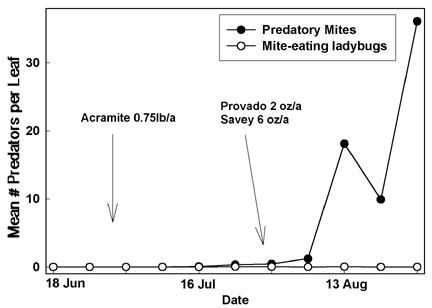
Bifenazate and pymetrozine had minimal impact on the abundance of predatory mites or the overall community of beneficial arthropods in the monitored hop yards (Figures 1-3). In contrast, fenpyroximate had an adverse impact on populations of beneficials (Figures 2-3). Imidacloprid (at one quarter of the recommended rate) appeared to reduce the overall community of beneficial arthropods (Figure 2). However, predatory mite (mainly G. occidentalis) numbers increased substantially following the use of this insecticide (Figure 4).
FIGURE 1 |
Effect of bifenazate (Acramite) on the beneficial arthropod community in Hop Yard 1 during 2001. |
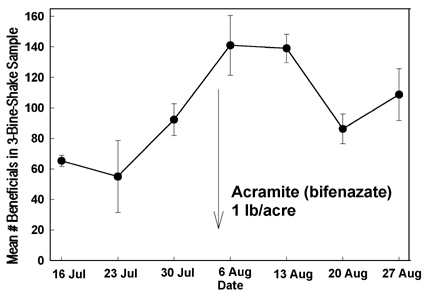 |
FIGURE 2 |
Effect of selected pesticides on beneficial arthropod communities in Hop Yards 2 and 3 during 2001. |
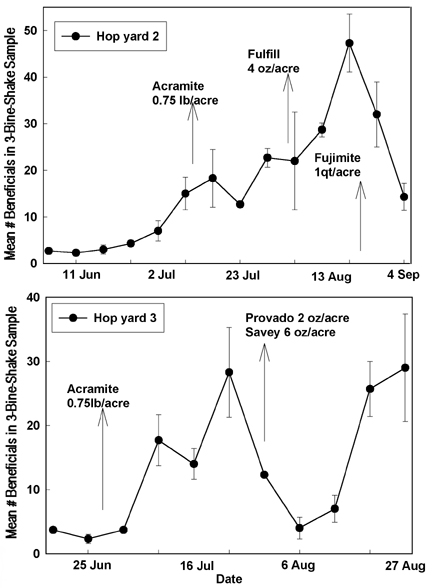 |
FIGURE 3 |
Effect of selected pesticides on predatory mite populations in Hop Yard 2 during 2001 |
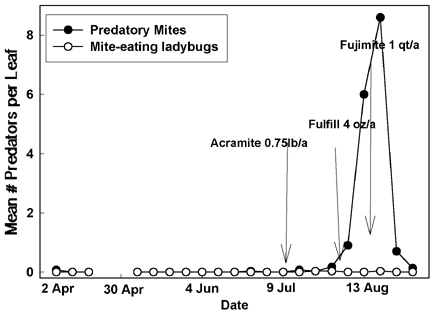 |
FIGURE 4 |
Effect of selected pesticides on predatory mite populations in Hop Yard 2 during 2001. |
 |
Eighteen months after its inception, this project has resulted in the creation of a significant and rapidly expanding database on the toxicity of commonly used and new pesticides on some important beneficial arthropods resident, or potentially resident, in Washington hop yards and vineyards. The three predatory mite and two lady beetle species are also important in other agroecosystems in Washington, extending the relevance of this project to other industries. I believe the safety tables are a good guide to the compatibility of specific miticides, insecticides, and fungicides to biological control and IPM. Certainly the field data thus far obtained for bifenazate, fenpyroximate, pymetrozine, and imidacloprid support the conclusions provided by laboratory bioassays.
Fenpyroximate, bifenazate, and pymetrozine were available to hop growers under a Section 18 for the first time in 2001. They are likely to become the basis for mite and aphid management in hop yards for the next few years. These compounds were chosen for use in hops due to their efficacy against target pests and their relative compatibility with biological control agents, using information gained from the WSU project. Bifenazate is an effective miticide and also appears to be relatively safe to beneficial arthropods. It is labeled for use at 0.75 to 1.5 lbs/A (pounds per acre). In laboratory tests, the highest labeled rate of this compound (1.5 lbs/A) did not kill 100% of the predatory mite and lady beetles species tested; around 50% mortality was usual. At the lower rates of 0.75 and 1.0 lb/A, mortalities were usually below 33% for most species. This contrasts with the industry standard miticide, abamectin, which, when used at full rate in laboratory tests, consistently resulted in 100% mortality. Furthermore, field evidence in 2001 indicated bifenazate at the lower rates had very little effect on G. occidentalis or the beneficial arthropod community in general. Bifenazate, therefore, appears to be a very useful IPM tool for mite (and aphid) management in hops. For the first time, hop growers have an effective miticide that kills motile stages, but does not destroy the beneficial arthropod complex. Consequently, biological control using endemic natural enemies can be considered an additional control tactic when this miticide is used. The appropriate timing for use of bifenazate in a hop IPM program is likely to be mid-season (July) if natural enemies appear to be struggling to control mites. A well-timed application should reduce mite numbers, while allowing the natural beneficial arthropods to take over control during August. Bifenazate will soon be registered for use in wine grapes where it will provide the same opportunities for improvements in IPM.
In laboratory tests and field studies, fenpyroximate (Fujimite), the second new miticide, appears to be far more harmful to beneficial arthropods than bifenazate. All rates of fenpyroximate gave 100% or near 100% mortality to all the beneficial species tested in the laboratory. This severe effect on beneficials appeared to be confirmed by the sampling data from Hop Yard 2. The use of fenpyroximate in hop IPM is best reserved for rescue treatments when biological control is not working and bifenazate cannot be used (bifenazate use is currently restricted to one application per season).
Pymetrozine is an aphicide combining good efficacy with great safety to beneficial arthropods. In laboratory tests, the full rate had low toxicity to all the beneficial species tested. This selectivity to beneficials was further demonstrated by observations in Hop Yard 2 where neither G. occidentalis or the general beneficial arthropod community were adversely affected. Pymetrozine is intended to be an alternative to imidacloprid for aphid control on hops. Imidacloprid is generally harmful to beneficial arthropods even at reduced rates (see below). In addition, evidence is accumulating to suggest it is a stimulant to spider mite oviposition (3). The low impact of pymetrozine on beneficial arthropods makes it an important component of IPM in hops.
As reported in the February 2001 issue of Agrichemical and Environmental News, imidacloprid at the full field rate is harmful to predatory mites and lady beetles (2). For experimental purposes, we observed the effects of imidacloprid applied at one-quarter rate in Hop Yard 3. This rate appeared to have a detrimental impact on the overall beneficial arthropod community, but not on the predatory mite G. occidentalis. This latter predator showed a spectacular increase in population size after exposure to imidacloprid. Besides being implicated in stimulating oviposition in spider mites (3), imidacloprid is known to increase egg laying in at least one species of predatory mite (1). Thus, it is possible that a reduced rate of imidacloprid, instead of killing G. occidentalis, increases oviposition and population development. Obviously, further research is required. Using rates below the labeled rate is not recommended, and could in fact lead to resistance development. In hops and grapes, use of the systemic formulation of imidacloprid is encouraged, because of its likely reduced impact on beneficials compared to the foliar-applied formulation (Provado).
The toxicity of lime and/or wettable sulfur to predatory mites is of particular significance to grape growers, many of whom routinely use these materials for powdery mildew control. Adverse impacts of sulfur on predatory mite populations have also been seen in field studies in vineyards, particularly when sulfur is the only material used for disease control, and multiple applications are made. Early-season sulfur and broad-spectrum insecticide (e.g., carbaryl, chlorpyrifos, methomyl) applications, all of which are toxic to the beneficial arthropods we have examined so far, are probably one of the major reasons why secondary pests like spider mites are a problem in Washington vineyards. Hopefully, this project in due course will identify vineyard pesticides that are more compatible with IPM/biological control, improving the prospects for reduced chemical inputs in the way that bifenazate and pymetrozine have done for hops.
Dr. David James is with WSU’s IAREC facility in Prosser. He can be reached at (509) 786-9280 or djames@tricity.wsu.edu.
AcknowledgmentsI wish to thank Jennifer Coyle, Tanya Price, Larry Wright, Joe Perez, and Maria Mireles for their invaluable technical assistance in this project. David James |
TABLE 1 |
||||||
Safety ratings of selected pesticides against selected beneficial arthropods in Washington hop yards. Ratings derived from direct toxicity laboratory bioassays. |
||||||
| Type of Pesticide |
Galendromus
occidentalis
|
Neoseiulus
fallacis
|
Amblyseius
andersoni
|
Stethorus
picipes
|
Harmonia
axyridis
|
|
| MITICIDE | Abamectin | H | H | H | H | H |
| Cyhexatin | H | H | ------ | ------ | ------- | |
| Propargite | S | S | MH | H | S | |
| Hexythiazox | S | S | S | S | S | |
| Fenpyroximate | H | H | H | H | H | |
| Bifenazate | MH | MH | H | MH | MH | |
| Milbemectin | H | H | H | H | MH | |
| Biomite | H | H | H | H | S | |
| Dicofol | ------- | ------- | ------ | ------- | S | |
| Fenbutatin Oxide | MH | S | S | ------- | S | |
| Acaritouch | MH | S | S | ------ | ------- | |
| INSECTICIDE | Imidacloprid | H | H | MH | H | H |
| Pirimicarb | H | S | ------ | H | S | |
| Chlorpyrifos | H | H | H | MH | H | |
| Bifenthrin | H | H | H | H | H | |
| Thiamethoxam | ------- | ------- | ------- | H | MH | |
| Endosulfan | ------- | ------- | ------- | ------- | S | |
| Malathion | ------- | ------- | ------- | ------- | H | |
| Dimethoate | ------- | ------- | ------- | ------- | H | |
| Carbaryl | H | H | ------- | ------- | H | |
| Methomyl | H | H | H | ------- | H | |
| Pymetrozine | S | S | S | S | S | |
| Diazinon | MH | H | H | ------- | H | |
| FUNGICIDE | Myclobutanil | S | S | -------- | S | S |
| Trifloxystrobin | S | S | S | -------- | -------- | |
| Quinoxyfen | S | ------- | -------- | -------- | -------- | |
| Wettable Sulfur | MH | S | MH | -------- | MH | |
| Lime Sulfur | H | H | S | -------- | -------- | |
|
S = SAFE: less than 33% mortality expected when field rate used. MH = MODERATELY HARMFUL: 33-66% mortality expected when field rate used. H = HARMFUL: 66-100% mortality expected when field rate used. |
||||||
Washington State University (WSU) provides
pre-license and recertification training for pesticide applicators. Pre-license
training provides information useful in taking the licensing exam.
Recertification
(continuing education) is one of two methods to maintain licensing.
(The other is retesting every five years.)
Course registration (including study
materials) is $35 per day if postmarked 14 days prior to the first day
of the program you will be attending. Otherwise, registration is $50 per
day. These fees do not include Washington State Department of Agriculture
(WSDA) licence fees.
For WSDA testing sites, schedule, or other testing information, call 1-877-301-4555.
For more detailed information about WSU's pesticide applicator training, call the Pesticide Education Program at (509) 335-2830 or visit the Web site at
UFungicides are critical components of many tree fruit and vine disease management programs. Without them, powdery mildew and other plant diseases would be difficult, if not impossible, to control during years of high disease pressure.
Until the advent of the benzimidazoles (e.g., Benlate) in the 1960s, sulfur and other protectants were the primary fungicides for fruit disease management. In some areas, benzimidazoles were used extensively for mildew control until their use gradually declined due to resistance concerns.
Demethylation-inhibiting fungicides (DMIs, also known as sterol-inhibiting fungicides or SIs) first entered the marketplace in the late 1970s.For almost two decades, these have been our primary line of defense against powdery mildews and apple scab.
It has been documented that fungal pathogens can gradually lose their sensitivity to DMI fungicides under repeated and prolonged usage. The most widely known example in fruit crops was the development of Bayleton resistance by Uncinula necator, the grape powdery mildew pathogen. Bayleton first entered the California grape market in the early 1980s and was initially considered a panacea against powdery mildew. Within several years, total control failures had been documented. Today, the compound is seldom used to control grape mildew by our neighbors to the south.
Resistance to the DMI compounds has been documented in a number of other crops as well. Control failures have been reported when certain DMI fungicides have been used extensively against Podosphaera clandestina, the cherry powdery mildew pathogen. We have not documented any control failures in apple, but patterns of intensive DMI use on apples and other crops result in a high risk for resistance.
It is now known that two of the keys to resistance management are minimizing the number of fungicide applications and alternating fungicides with different modes of action. Until recently, growers had very few effective alternatives besides sulfur compounds to alternate with the DMI fungicides when trying to control powdery mildews. The emergence of the new strobilurins fungicide class has brightened the grower’s future.
One of the more exciting advances in disease control during the last decade has been the discovery, development, and marketing of strobilurin fungicides. Chemically, the strobilurins are a unique class of fungicidal compounds derived from or related to oudemansin or strobilurin A, compounds produced by the woodland mushrooms Oudemansiella mucida or Stobilurus tenacellus, respectively (2). These compounds inhibit other fungi that could compete for nutrients in the rotting plant material.
Several companies have developed synthetic strobilurin products. The first to enter major markets in Washington State was Abound (azoxystrobin). Abound is currently registered for use against, among other things, grape and cherry powdery mildew and shothole of stone fruits including cherry. Abound is extremely phytotoxic to certain apple varieties (e.g., Gala) and should be used with caution if the cherry orchard or grape vineyard to be treated is in close proximity to apple orchards or if using the same sprayer to treat multiple crops.
Sovran (kresoxin-methyl) and Flint (trifloxystrobin) are registered for use on apples, other pome fruits, and grapes for powdery mildew and other diseases. Sovran and Flint offer the additional benefit of excellent activity against apple scab and should improve our control of fruit scab when mixed or alternated with DMI fungicides.
Strobilurins will fit into our spray programs as protectant fungicides, meaning they need to be on the plant surface before the pathogen gets there and before the disease intensifies. Strobilurins are good or relatively good stand-alone mildewcides, but in our studies seem to perform equally as well or better when used in alternation with DMI fungicides.
Strobilurins have some curative activity, but their primary use should be as protectants. They should not be used as eradicants because this will increase the risk of resistance.
The way in which the fungicide affects the fungus is known as the compound’s mode of action. Some fungicides have wide modes of action, meaning that they affect sensitive fungi at numerous biochemical points or in numerous ways. Others, such as anilopyrimidines (APs), DMIs, strobilurins, and benzimidazoles, have narrow modes of action, which means they affect the fungus at fewer biochemical points. The narrowest mode-of-action fungicides are known as site-specific compounds, meaning that they interfere with one essential biochemical step (or site) in the pathogen’s metabolism. Site specificity can be monogenic (affecting one gene), as in the case of the benzimidazoles, or polygenic (affecting multiple genes or gene types), as in the case of DMI, strobilurin, and AP fungicides.
The narrow mode-of-action, site-specific fungicides that are at highest risk for resistance development include DMI fungicides such as Bayleton, Rally, Rubigan, Procure, Funginex, Elite, Orbit, and Indar. These site-specific, locally systemic compounds affect susceptible fungi by interfering with the synthesis of ergosterol, a necessary component of fungal membranes. Because the biosynthesis of ergosterol is site-specific and under the biochemical control of a few genes, the risk of resistance development to DMI fungicides is relatively high. Strobilurins such as Abound, Flint, and Sovran are site-specific, locally systemic compounds with modes of action that disrupt energy production in the fungus. For this reason, they are potent inhibitors of spore germination. I consider the resistance risk of strobilurins to be moderate to high because of their site-specificity. Benzimidazole fungicides are absorbed by the fungus and prevent the formation of mitotic spindles, which interferes with the normal process of cell division. Sulfur compounds are active in the vapor phase (which is why they work only under a narrow temperature range), preventing spore germination. Oil fungicides may have protective, eradicant, and antisporulant activity. An in-depth study on the modes-of-action of petroleum and plant oils was published by Northover (1).
In summary, AP, DMI, strobilurin, and benzimidazole fungicides have site-specific, narrow modes of action, while oils, sulfur, and soaps have wide modes of action. The resistance risk of the former group is high and of the latter group is low. Neither strobilurin nor AP fungicides show cross-resistance to members of other fungicide classes, but the reader should keep in mind that research on this phenomenon in the strobilurins is still in an early phase.
During prolonged exposure to DMI fungicides, the pathogenic fungus gradually loses its sensitivity to the registered rates of the compound. Prior to exposure to DMI fungicides, a wild-type powdery mildew population will include individuals sensitive to low, average, and high doses of the fungicide, (e.g., 2 oz. per acre and higher), individuals susceptible to average and high doses (e.g., 4 oz. per acre and higher), and individuals sensitive to high doses (e.g., 6 oz per acre and higher). The low- and medium- dose sensitive fungi are selected out of the population over time. Eventually the population consists of individuals that can be eliminated only by high doses of the fungicide. In the orchard or vineyard, this eventually manifests as a loss of control. Growers find themselves having to spray more often and at higher rates in order to maintain an adequate level of control. Under high disease pressure, when the pathogen is reproducing rapidly and multiple DMI sprays are applied, the shift towards a population consisting of “high-dose” individuals can occur within one growing season. This is why it is imperative to alternate fungicide classes during the growing season. Numerous factors affect fungicide resistance development.
Nature of
the chemical. Site-specific, narrow mode-of-action (AP, DMI,
strobilurin, and benzimidazole) fungicides have a higher inherent resistance
risk than compounds with wide modes of action (oils, soaps, sulfurs, and
EBDCs or Ethylene bis-dithiocarbamates).
Intensity and timing of usage. Using
a site-specific fungicide in an eradicative (after-the-fact) manner poses
a higher resistance risk than using it in a protective manner. Using resistance-prone
compounds after a disease has become well established exposes a larger
pathogen population to the chemical. Using one or closely related compounds
continuously and exclusively increases the risk of resistance.
Nature of the pathogen. Any pathogen that reproduces rapidly, spreads through the air, and reproduces sexually is more likely to develop resistance. The powdery mildew, apple scab, and brown rot pathogens all meet these criteria.
Proportion of naturally occurring resistance strains in the population. A larger proportion of naturally occurring resistant strains in the wild-type population will increase the risk of resistance development.
The American Phytopathological Society’s recommendations for avoiding fungicide resistance are provided in the box at the end of this article.
Resistance has been studied in azoxystrobin
(Abound), one of the compounds considered at moderate risk for inciting
resistance. The resistance risk can be minimized by applying optimal doses
and by avoiding sublethal or suboptimal doses (in other words, by following
the directions on the product label).
Strobilurin resistance development is a multi-step process favored by
low doses of the fungicide. Strobilurins should be used preventatively
and should not be used to attempt to bring mildew under control once it
has intensified. They should always be applied at the rates specified
on the label. The strobilurin proportion should not exceed 30 to 50 percent
of total spray applications per season. Strobilurins should be alternate
or “blocked” with fungicides of other classes. “Blocks”
are a structured type of alternation. For example, a block could be two
consecutive strobilurin sprays followed by two consecutive DMI sprays
then by two more strobilurin sprays. For mildew control the strobilurins
can be alternated or blocked with oils, sulfur compounds, or DMI fungicides.
If strobilurins are used in blocks, use them in blocks of one to three
sprays. Always be sure that the strobilurin blocks are separated by at
least two sprays of a fungicide with a different mode-of-action.
Fungicide resistance management is a multifaceted process. One of the key components of it is the alternation of different fungicide chemistries. The new AP, strobilurin, and oil fungicides provide us with more tools for disease control and are also excellent resistance-management tools. The wise use of strobilurin fungicides will keep them working for us for years to come.
Dr. Gary G. Grove is a Plant Pathologist
with WSU’s Irrigated Agriculture Research and Extension Center (IAREC)
in Prosser. He can be reached at (509) 786-2226 or grove@wsu.edu.
Resistance Reduction
|
Damsel bugs, Nabis spp. (Heteroptera: Nabidae), are one of the larger and more effective predators in Washington agricultural fields.

When we say “large,” of course we mean that damsel bugs are large by bug standards: adult damsel bugs can reach about three-eighths of an inch in length. They are slender, grayish brown insects with large protruding eyes on the sides of their thin heads. Adult damsel bugs have wings, while those in the nymph stage look like smaller, lighter-colored, wingless versions of the adults,
Damsel bugs are common in a wide variety of crops throughout Washington State. They are active throughout the growing season, from about mid-May until early October. Damsel bugs go through at least two generations per year. In the spring we see mostly adults, while later in the year the nymphs can be very common.
If you look closely at a damsel bug, you’ll see that they resemble a small praying mantis, with folded front legs that make them look like they are praying. Entomologists call these “raptorial” legs, and they are used to capture prey. The damsel bug and the praying mantis are only distantly related, but have a similar appearance because they hunt in a similar way. Both are ambush predators. This means they sit and wait for prey to come within reach and then lunge at them with their raptorial front legs.
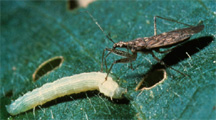 Damsel
bugs are generalists that feed on many different prey species. Like big-eyed
bugs (AENews’ featured “Bug of the Month” in the
October 2001 issue, No. 186),
damsel bugs feed by piercing their prey with their sharp mandibles (mouthparts)
and then drinking their victim’s bodily fluids. Because they need
to pierce their prey to eat them, damsel bugs prefer soft-bodied insects
like caterpillars, beetle larvae, and aphids.
Damsel
bugs are generalists that feed on many different prey species. Like big-eyed
bugs (AENews’ featured “Bug of the Month” in the
October 2001 issue, No. 186),
damsel bugs feed by piercing their prey with their sharp mandibles (mouthparts)
and then drinking their victim’s bodily fluids. Because they need
to pierce their prey to eat them, damsel bugs prefer soft-bodied insects
like caterpillars, beetle larvae, and aphids.
The relatively large size of damsel bugs makes them particularly important predators. We have been studying which predators feed on two common potato pests, the green peach aphid and the Colorado potato beetle. Many of the predators feed on aphids, because aphids are small and cannot do much to defend themselves. But, of the predators we examined, only damsel bugs fed heavily on Colorado potato beetle larvae, which are too large for many smaller predators to subdue.
The significance of the damsel bug in the Colorado potato beetle predator population illustrates the importance of conserving predator diversity in agricultural fields. Different predator species attack different pest species and stages, therefore the presence of more predator species leads to more complete control.
An integrated pest management (IPM) approach emphasizes preservation of beneficial predators and use of softer pesticides. Like other beneficial insects, damsel bugs are very susceptible to broad-spectrum pesticides. Working in potato fields in Washington, we have found that damsel bugs are ten times more abundant in fields treated with selective pesticides than they are in fields treated with organophosphates. Damsel bugs, working together with other predators, can slow the rate of pest resurgence following application of softer pesticides, making fewer treatments necessary than would be required if broad-spectrum pesticides were used.
Bill Snyder and Amanda Fallahi are with the Department of Entomology at Washington State University in Pullman. Dr. Snyder can be reached at (509) 335-3724 or wesnyder@wsu.edu.
The Pesticide Notification Network (PNN) is operated by WSU's Pesticide Information Center for the Washington State Commission on Pesticide Registration. The system is designed to distribute pesticide registration and label change information to groups representing Washington's pesticide users. PNN notifications are now available on our web page. To review those sent out in the month two months prior to this issue's date, either access the PNN page via the Pesticide Information Center On-Line (PICOL) Main Page on URL http://picol.cahe.wsu.edu/ or directly via URL http://www.pnn.wsu.edu. We hope that this new electronic format will be useful. Please let us know what you think by submitting comments via e-mail to Jane Thomas at jmthomas@tricity.wsu.edu.
|
|
|
|
W.S.U. Pullman Home Page

Comments and questions: cdaniels@tricity.wsu.edu
Technical Assistance: scoates@tricity.wsu.edu
Copyright © Washington State University / Disclaimer
Electronic Publishing and Appropriate Use Policy
University Information: 509/335-3564
